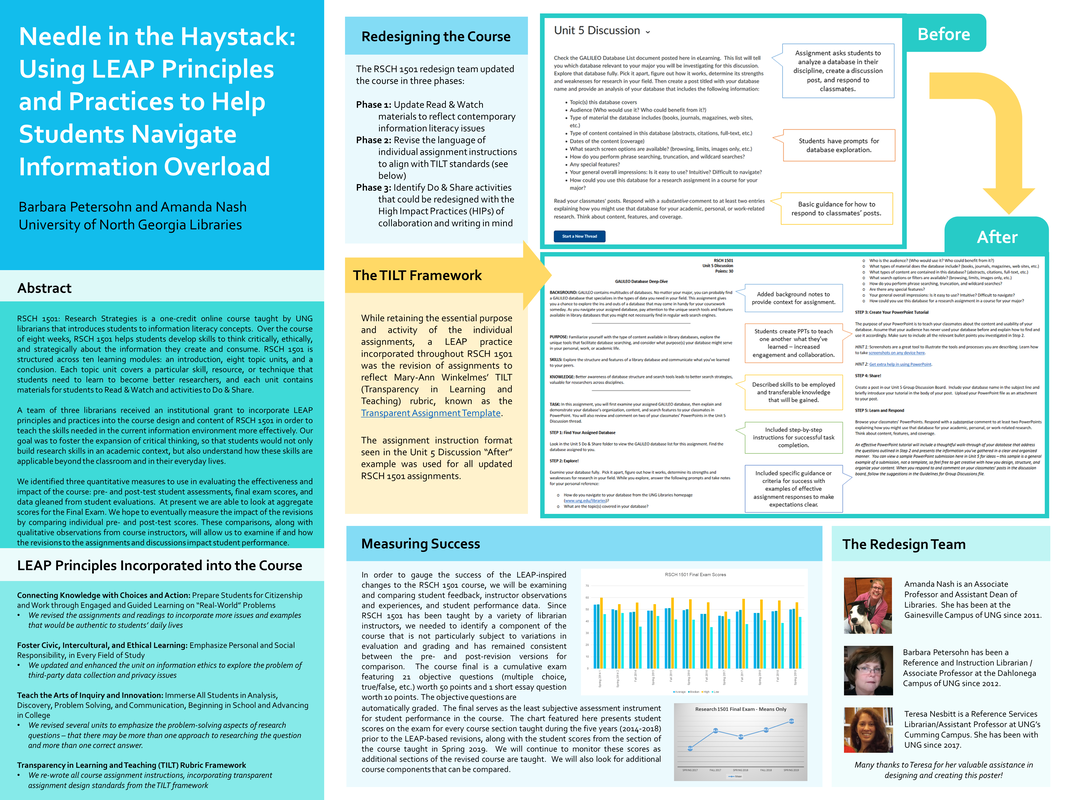
 Our Needle in a Haystack poster describes the process we followed in incorporating the Association of American Colleges & Universities’ LEAP principles in to an information literacy course, including examples of how activities and assignments were transformed based on these principles and how we assessed improvements in learning. For more information about LEAP (Liberal Education and America’s Promise), see https://www.aacu.org/sites/default/files/files/LEAP/Introduction_to_LEAP.pdf Barbara Petersohn, University of North Georgia
Amanda Nash, University of North Georgia
7 Comments
Amanda Nash
4/22/2021 04:55:16 pm
Thank you for taking time to view our poster!
Rebecca
4/26/2021 10:43:46 am
Thanks for sharing all of your work! It looks like you made a lot of thoughtful improvements by incorporating the LEAP principles. Can you share some examples of the readings and/or discussions you incorporated as part of "connecting knowledge with choices and actions"? 4/26/2021 04:58:40 pm
Hi Rebecca ! Thanks for stopping by to view and comment! I'm copying links to Google docs with two parts of two units in the Research Strategies class-- Internet searching and Information ethics. (These are in need of updating from the previous semester and a couple internet links need to be replaced. Also, there are a couple of items in the Read and Watch list which are behind our school login). But this should give you a general idea of what background reading / viewing was required and what the discussion questions were like.
Susan Montgomery
4/26/2021 05:48:50 pm
Hi!
Amanda Nash
4/26/2021 10:00:51 pm
Hello, Susan! Thanks for your question. The course is built in our university's CMS, so the modules are not available to the public. The course is designed for early college students, ideally first year, but we get students at all levels. Currently, we teach the class twice a year with anywhere from 10-20 students enrolled in each class. In previous years, the course was a core curriculum elective, and we taught 5-6 sessions each semester with 25 students each. Institutional changes brought an overhaul of the core, and our class was an unfortunate casualty of those changes. A major update to the core, with a focus on information and data literacy included, is slated in the next couple of years, and we are hopeful that the class will be reincorporated.
Maryke Barber
4/27/2021 05:38:37 pm
I appreciated the example of the TILT framework, and I also like the idea of having students create a PowerPoint slide! In the spirit of UDL I've started giving students choices (give a presentation, or make a video...) but I also like the idea of a single slide for simple assignments. 4/28/2021 08:24:06 am
Yes, we wanted to offer other kinds of communication / writing formats for the assignments, but also one that most students would be familiar with. Your comment will be posted after it is approved.
Leave a Reply. |
Thank you for visiting the TILC 2021 Poster Session!
ArchivesCategories |
 RSS Feed
